This is general guidance, not legal advice. The law on recording conversations differs between countries and, in the United States, between states, and it changes. If a recording matters, for a legal dispute, an employment process or journalism, check the current law where you and everyone else in the meeting are, or ask a lawyer.
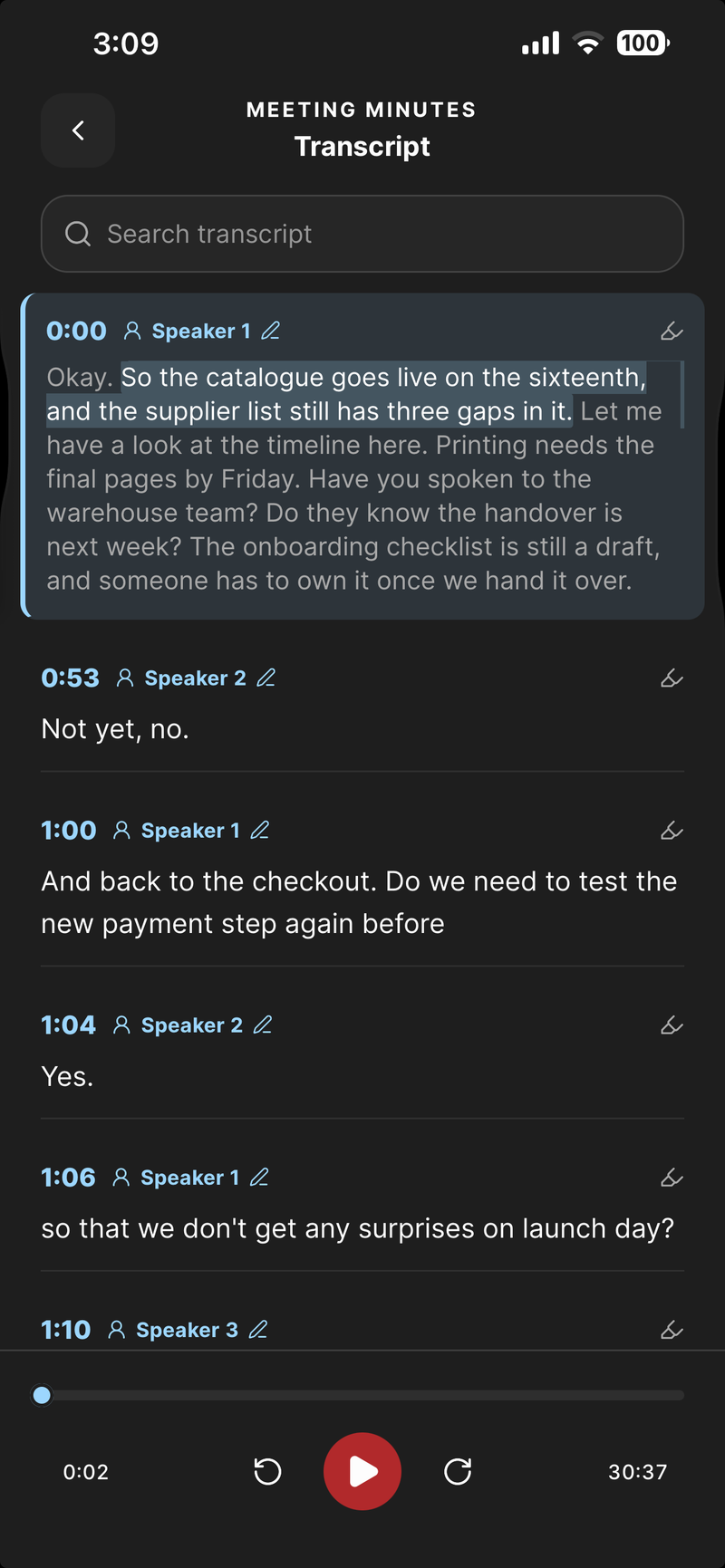
Recording a meeting is ordinary and useful: it is how the minutes, the transcript and the follow-up get written without anyone taking notes. It is also the moment you are most likely to need other people’s permission. This guide explains why, how the rules differ, and the habit that covers you almost everywhere. It applies to any meeting recorder, including one on your phone.
The habit that covers you almost everywhere
Before you start recording:
- Tell everyone that you would like to record, and why.
- Ask whether they are comfortable with it, and do not record if someone says no.
- Say it again once the recording is running, so the agreement is in the recording itself, with its timestamp.
For example: “Before we start, I’d like to record this so I can write accurate notes afterwards. Is everyone OK with that?”
Doing this is the stricter standard in almost every place described below, so it is the safe default when you are not sure which rules apply, or when people are joining from different places.
Two kinds of law
Two different kinds of law can apply to a recording.
Recording and interception laws decide whether it is lawful to record a conversation at all, and whose consent that needs. Breaking them can be a criminal offence.
Data protection laws apply mainly to organisations. A recording that identifies people is personal data, and these laws decide what an organisation must tell people and how it may use and keep the recording.
A recording can be lawful under the first and still need notice under the second.
United States
Federal law allows a person to record a conversation they take part in, or one where a participant has agreed, as long as the recording is not made to commit a crime or a civil wrong. This is often called one-party consent.
Many states follow the same rule, but a group of states requires the consent of every party. The Digital Media Law Project lists California, Connecticut, Florida, Maryland, Massachusetts, Montana, New Hampshire, Pennsylvania and Washington among them, and notes that Massachusetts bans secret recordings rather than requiring explicit consent from everyone. State rules differ in their detail, for example between phone calls and conversations in a room, so check the state’s own law.
When people join from more than one state, assume the stricter rule applies.
Canada
The Criminal Code makes it an offence to intercept a private communication, with an exception for a person who has the consent of the person who made the communication or the person it was meant for. In practice, a participant in a conversation can generally record it. Organisations still have privacy obligations about how they collect and use recordings.
United Kingdom
The Information Commissioner’s Office explains that organisations must tell people what they are doing with their personal data at the time they collect it: the purposes, how long it will be kept and who it will be shared with. For a recorded meeting, that means telling people before you record, not afterwards. The EU’s GDPR, which UK data protection law is based on, sets the same expectation for organisations.
Germany
Germany is an example of a country where recording itself can be a crime. Section 201 of the Criminal Code makes it an offence to record another person’s non-public spoken words without authorisation, or to use or share such a recording, with a penalty of up to three years’ imprisonment or a fine. Consent is what makes the recording authorised.
United Arab Emirates
Article 44 of Federal Decree-Law No. 34 of 2021, the UAE’s law on countering rumours and cybercrime, makes it an offence to invade someone’s privacy using information technology, including by eavesdropping on or recording conversations without consent. Legal commentary on the law describes penalties that include detention and substantial fines. Get everyone’s agreement before recording a meeting in the UAE.
Pakistan
In March 2026, the Supreme Court of Pakistan held that secretly recording a private conversation without the consent of the people in it is illegal, according to reporting on the judgment. Treat consent from everyone in the meeting as required.
India
India’s Digital Personal Data Protection Act, 2023 sets rules on notice and consent for organisations that process digital personal data. The Rules that put those obligations into effect were notified in November 2025, and the core notice and consent requirements take effect eighteen months after that. Organisations recording meetings in India should plan for them now.
Everywhere else
If your country is not listed here, the habit at the top of this page is the right default. Ask first, record the agreement, and do not record anyone who says no.
Situations that need extra care
- Client meetings. Tell the client what the recording is for and who will see it. See client meeting notes.
- Interviews. Research ethics boards and employers often have their own consent rules on top of the law. Ask before the interview and again once the recording is running. See recording interviews.
- One-on-ones and performance conversations. Record only when both people agree each time.
- Workplace policies. Your employer may have rules about recording meetings even where the law would allow it.
How EchoPilot fits in
EchoPilot records on your own device and never sends a bot into a call, so nothing announces the recording for you. Saying that you are recording is your job, and it is the first thing to do.
A few things help you stay in control of what you recorded. A recording only ever starts when you confirm it. You can delete a recording at any time; it goes to a bin for a short period so it can be restored, and is then removed. You can export only the part of a meeting you need, such as the summary and notes without the transcript. And because the transcript keeps a timestamp on every line, the moment you asked for agreement is part of the record.