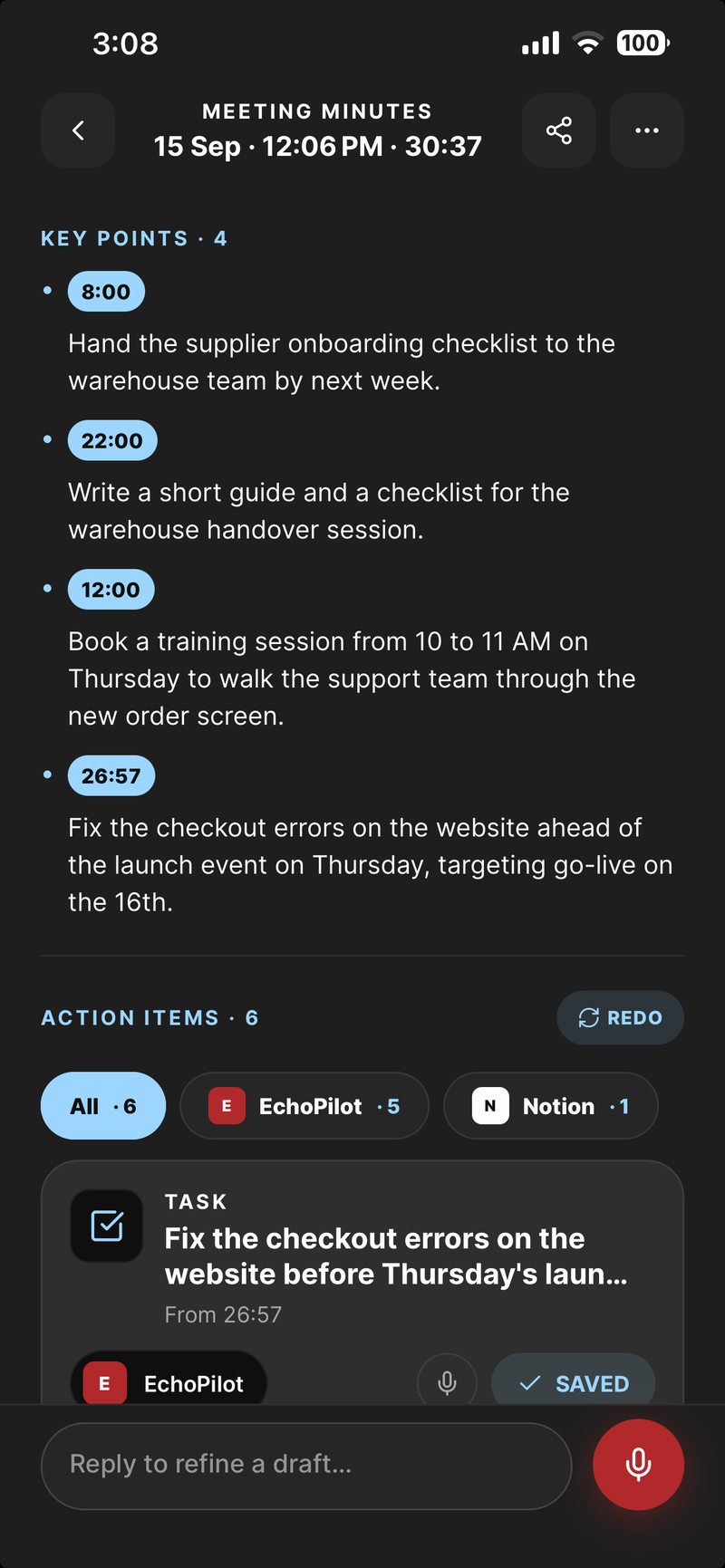
Most unclear minutes have the same problem: decisions, action items and discussion are mixed together in one paragraph, so nobody can tell what was settled and what still needs doing. Separating them is the single change that makes minutes useful, and it is the separation meeting actions in EchoPilot are built on.
Three quick tests
A decision changes what is true. After it, something is settled: a date, a choice, a rule. It needs no owner. “The launch date is 1 October” is a decision.
An action item changes who does what next. It has one owner, a clear finish, and usually a due date. “Aisha sends the pages to legal by Monday” is an action.
A note explains why. It is the context, the reasoning or the risk that someone reading later will need to understand a decision. “Legal review is slower than planned because of the new privacy rules” is a note.
If a sentence passes none of the tests, it probably does not belong in the minutes.
Sorting real sentences
| What was said | What it is | Why |
|---|---|---|
| “Let’s go with the cheaper supplier.” | Decision | It settles a choice. Nobody has to do anything for it to be true. |
| “I’ll email them the order on Tuesday.” | Action | One owner, one task, one date. |
| “Their delivery times were worse last year.” | Note | Context for the decision. |
| “We should look at the pricing page at some point.” | Neither yet | No owner, no finish. Record it as an open question until someone takes it. |
| “Let’s aim for Friday.” | Depends | If it sets the deadline for everyone, it is a decision. If one person is aiming for Friday, it is the due date of their action. |
| “Can someone check the contract?” followed by “I will.” | Action | The second sentence gives it an owner. Write the owner, not the question. |
The edge cases
A decision that creates work. “We are switching suppliers” is a decision, and it creates actions: cancel the old contract, place the first order. Write the decision once, then each action separately.
An action with no owner. Do not invent one. Write it as an open question with the person who agreed to find an owner. An action item assigned to “the team” will not be done.
A decision someone disagreed with. Record the decision. Record the disagreement only if your organisation’s rules require it, or if it is a risk someone should watch, in which case it is a note.
A commitment made in passing. “I can send that over later” is still an action. These are the ones most often missed, because nobody wrote them down as tasks.
How to write each one
- Decisions: one sentence, present or past tense, no hedging. “Launch stays on 1 October.”
- Actions: verb first, then owner and date. “Send the revised quote to the client: Marco, Thursday.”
- Notes: as short as possible, and grouped under the agenda item they explain.
How EchoPilot keeps them apart
When a meeting is recorded with EchoPilot, the Meeting Minutes come back with key points, the decisions and conclusions the meeting reached, each tied to the moment it was said, and action items listed separately.
Every action item also becomes a card with a destination already chosen, such as a task in Todoist or Microsoft To Do, or an event in your calendar. A card shows the moment and the context it came from, and it flags what is missing, such as a date, a time, a recipient or an assignee, so you can see which commitments still need an owner before you approve anything. Nothing is created in any app until you confirm the card, and a commitment that was not really yours can simply be discarded.
The templates keep the same separation on paper, with decisions and actions in their own sections.