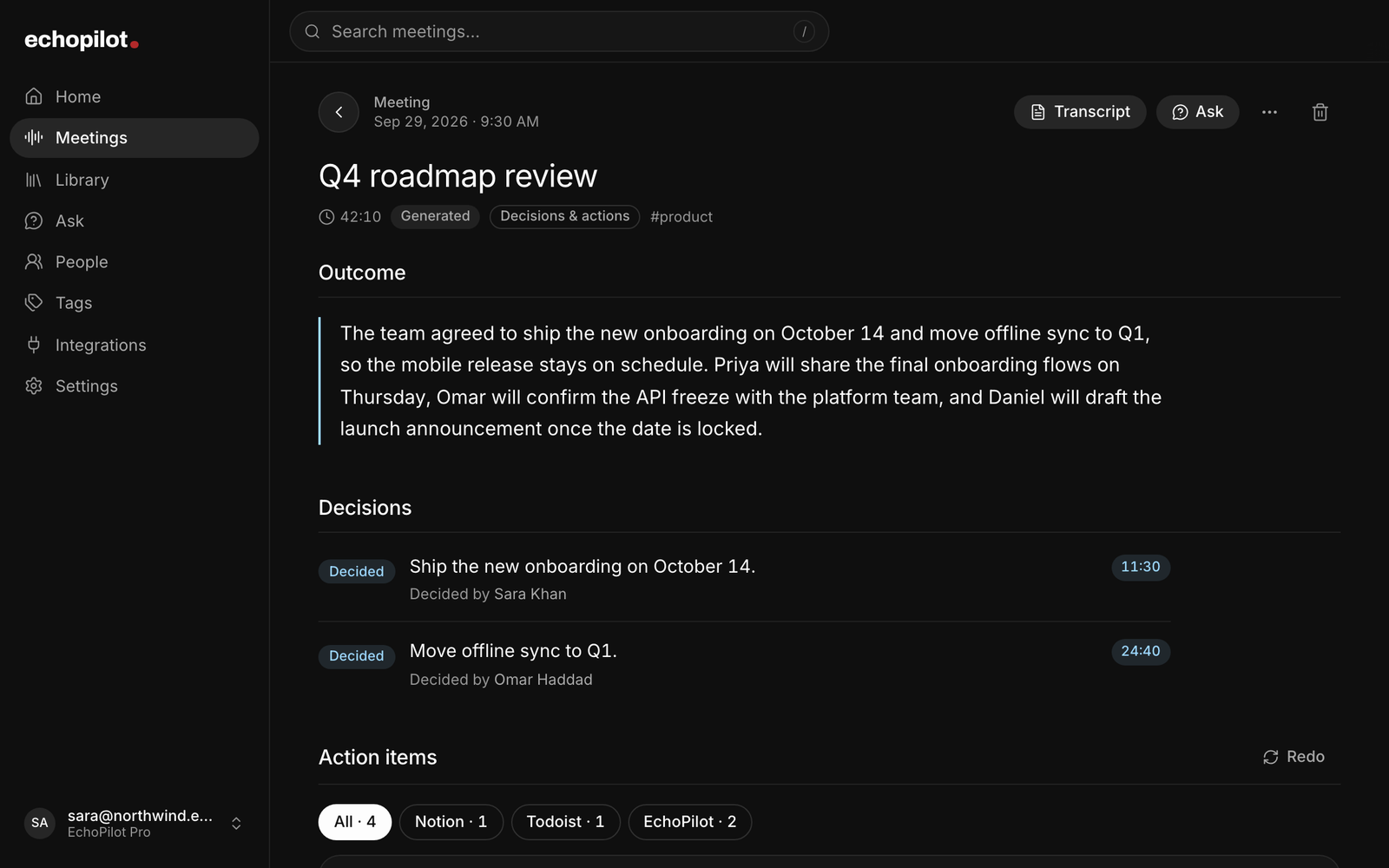
People use “meeting minutes” and “meeting transcript” as if they were two formats of the same thing. They are not. A transcript is the record: every sentence, in order, with the time it was said. Minutes are a reading of that record: what the meeting was about, what was decided, who owes what. One is evidence; the other is a conclusion drawn from it. Knowing which one you need, and when you need both, saves a lot of rereading.
What a transcript is for
A transcript answers “what exactly was said”. It is the document for the moments when wording matters: the figure the client quoted, the condition someone attached to their yes, the question an interviewee was actually asked. It is also the only honest basis for a correction, because when the minutes say something odd, the transcript is where you check.
A transcript fails as a working document. A one-hour meeting is nine thousand words, nobody reads nine thousand words to find one decision, and a transcript on its own tells you nothing about which of those words mattered.
What minutes are for
Minutes answer “what happened and what do we do now”. They are the document people act on: a summary, the key points, the decisions marked apart from the discussion, the open questions, the action items with owners. They are short enough to read before the next meeting and structured enough to search by eye.
Minutes fail when they are wrong, and they are wrong more often than they look, because they are confident by construction. A misheard name, a rounded number, an action assigned to the wrong person, two topics merged into one. Minutes with no transcript behind them cannot be checked, only believed.
Which one you need
- A decision or a commitment that someone will plan around: minutes, and the transcript line it came from.
- A dispute about what was agreed: the transcript, at the moment in question.
- Catching up on a meeting you missed: minutes first, the transcript only where the minutes are vague.
- An interview, a lecture, a doctor’s appointment: both, because the exact words matter and so does the structure. The right minutes for those are not standard minutes at all, but a template built for the kind of recording.
- A search three months later: the transcript, because the thing you remember may never have made it into the minutes.
Keep them linked
The useful arrangement is not minutes or a transcript, and not even minutes and a transcript as two separate files. It is minutes where every point knows the moment it came from, so that a tap on a key point plays the sentence that produced it, and a correction to the transcript marks the minutes built on the old words as out of date.
That link is what makes minutes checkable. Without it, verifying a summary means scrubbing through an hour of audio; with it, the check takes a few minutes, which is the difference between a summary people verify and one they forward unread.
How EchoPilot does both
One recording comes back as both documents. The minutes carry a title taken from the content, a summary, timestamped notes, key points, decisions, open questions and action items, written with a template chosen for the kind of recording: standard minutes for a meeting, lecture notes for a class, each question with its answer for an interview, the medicines and doses for a doctor’s appointment. Every key point cites the moment it came from.
The transcript sits underneath, searchable, with every line playing the recording from that moment and, on supported Pro meetings, speaker turns you can rename. Correct a misheard line and the original audio and text stay as evidence while the minutes are marked for a rebuild. Ask, which answers questions across your recordings, reads the corrected transcript and cites the moments it used. The two documents never drift apart, because they are the same recording read twice.