The weekly meeting is the one most likely to have no useful notes, because everyone assumes someone else remembers. Then the same question is raised in week six that was answered in week two, a task promised in March quietly disappears by May, and the new person has no way to catch up except asking. Recurring meeting notes are less about writing more and more about carrying the right things forward, which is also what the Meeting Minutes of a series should do for you.
What to carry from one meeting to the next
Open questions. Anything raised and not settled. A question that is not written down is not open; it is forgotten.
Tasks not yet done. With the owner and the date they were promised, and the meeting they came from. A task sent to a task app is still not done until someone says so.
Decisions, with their reasons. The decision survives; the reason gets lost, and then the decision is reopened by someone who did not hear it. One line of why saves a quarter of an hour in a later meeting.
Numbers that will come back. Budgets, dates, headcounts, the figure the client quoted. Numbers are what people misremember most confidently.
What changed. If the plan moved, say from what to what. A series of minutes that each describe only the current state cannot tell anyone how it got there.
What not to carry
Everything else. The discussion that led nowhere, the update that was only ever an update, the aside. Each meeting’s own notes keep those; the thread through the series should be short enough to read before the next meeting starts.
A structure that works
- Since last time. Two or three lines: what was decided, what was done, what is still open.
- This meeting. The notes as usual, with decisions marked apart from discussion.
- Carried forward. The open questions and the tasks still owed, each with an owner.
Written by hand this takes ten minutes after each meeting, which is why it rarely happens. It is also exactly the kind of work a recording can do for you, if the recordings know they belong together.
How EchoPilot keeps a series
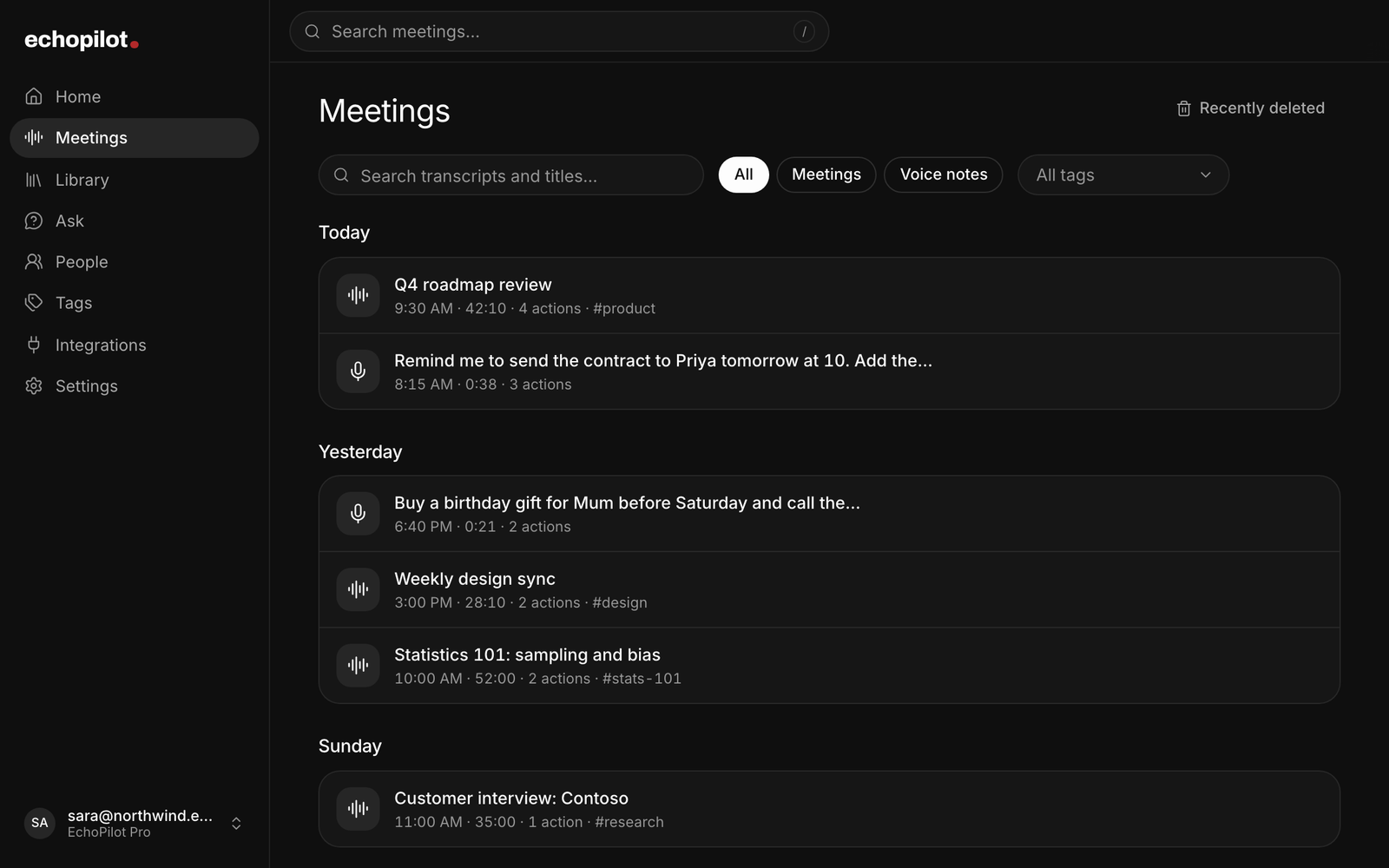
Meetings recorded from the same recurring calendar event form a series by themselves. A meeting that was not on the calendar, or an earlier one, can be linked from any meeting’s menu. The series page shows its meetings in order and the tasks still open across them, so a commitment from three meetings ago is still visible without opening three meetings.
Then Ask takes the whole series as its scope. “What did the client say about the timeline?”, “Has this objection come up before?”, “When did we change the launch date?” are answered across every meeting in the series, and every answer cites the moment it came from, so you can play the sentence rather than trust the summary. Ask is read-only: a question never changes a note.
Each meeting stays its own meeting, with its own minutes, transcript and action cards. The series is the thread, not a merge. (A meeting that was recorded in pieces is a different problem, and EchoPilot merges those into one set of minutes.)
What is next
What a series remembers before the next meeting is in development: the next meeting in a series opening with what was decided, promised and left open last time, read from the recordings rather than from anyone’s memory. Until then, the series page and Ask across the series do the same job one tap later.