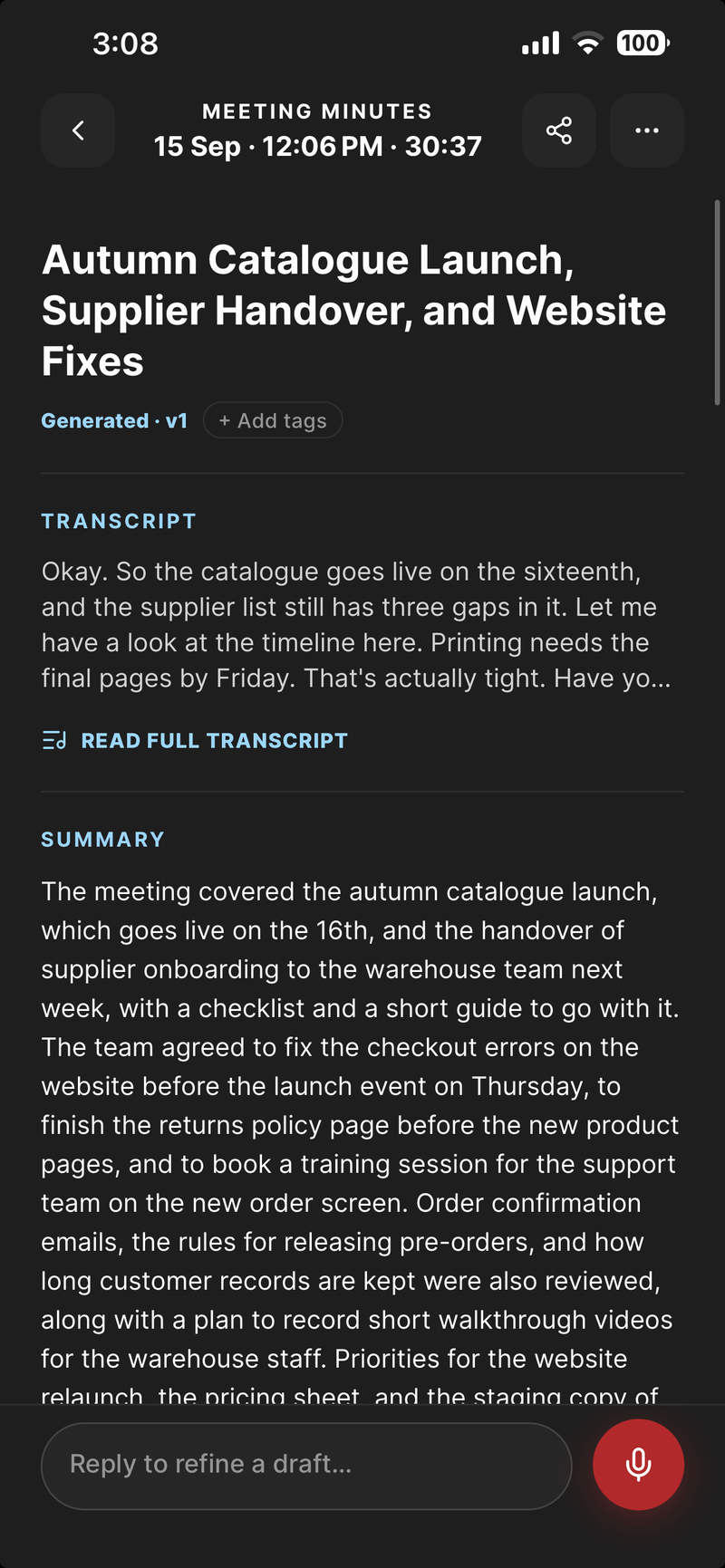
Meeting minutes are the written record of what a meeting decided and who agreed to do what. Good minutes are short, specific and out within a day. Bad minutes are either a transcript nobody reads or three vague lines that settle no argument.
This guide covers what belongs in minutes, how to write them during and after the meeting, a format that works for most meetings, and a worked example. If you would rather not write them by hand at all, Meeting Minutes in EchoPilot are written from a recording of the meeting, with every point tied to the moment it was said.
What minutes are for
Minutes exist so that people who were in the meeting agree later on what happened, and people who were not there can act on it. That gives them three jobs:
- Record decisions, so nobody reopens a settled question next week.
- Record actions, each with one owner and a date, so work does not fall between people.
- Keep enough context that a decision still makes sense to someone reading it in three months.
Anything that does not serve one of those jobs can usually be left out. Minutes are not a transcript, and they are not the place for who spoke longest.
Before the meeting
- Get the agenda. Minutes follow the agenda’s order, so you can set up the headings before the meeting starts.
- Pick a template. A consistent shape makes this week’s minutes comparable with last week’s. There are six free ones, for board, project, one-on-one, client, standup and informal meetings, on the meeting minutes templates page.
- Agree who writes them. The person running the meeting should not also be the only person taking notes.
- If you will record, say so at the start and ask whether everyone is comfortable with it. The guide to recording consent covers why that matters.
During the meeting: what to write down
Listen for four things, and write each one down as it happens.
- Decisions. What was agreed, in one sentence. “Launch moves to 1 October.” If a vote was taken, record the result.
- Actions. The task, the one person who owns it, and when it is due. If nobody takes ownership, write it as an open question instead, because an action without an owner is a wish.
- Key points of discussion. Only the reasoning people will need later, such as the risk that made the team choose the slower option.
- Open questions. Anything the meeting could not answer, and who will find out.
Write in short notes during the meeting. Full sentences can wait.
After the meeting: writing them up
Write the minutes the same day, while you can still read your own notes. A few rules make them far more useful:
- Lead with decisions and actions. Many readers will stop there.
- Use plain past tense. “The team agreed to…” rather than “We are going to maybe…”.
- Name people for actions, not for opinions. Minutes record what the group decided, not who argued which side, unless your organisation’s rules require it.
- Be specific. “Send the revised quote to the client by Thursday” beats “follow up on pricing”.
- Attach, do not copy. Link or attach the report or slide deck rather than retyping it.
- Send them to everyone who attended, and to the people who own actions if they were not there.
A format that works for most meetings
- Meeting title, date, time and place
- Attendees and apologies
- Summary in two or three sentences
- Decisions
- Actions, as a table of action, owner and due date
- Key discussion points, grouped by agenda item
- Open questions
- Date of the next meeting
Formal meetings add items such as quorum, declarations of interest and the exact wording of motions; the board template includes them.
A worked example
Weekly project review, Thursday 10 September
Present: Lena (lead), Marco, Aisha, Tom
Summary. The design is signed off; content migration is a week behind because product pages need legal review first. Launch stays on 1 October.
Decisions. Launch stays on 1 October. Archived blog posts move after launch, not before.
Actions. Aisha sends the first batch of product pages to legal by 14 September. Tom builds the redirect map for retired URLs by 16 September. Lena confirms the launch-day support rota by 17 September.
Open questions. Can legal review two batches in parallel? Aisha to ask.
Next meeting. Thursday 17 September.
Notice what is not there: who suggested moving the blog posts, the fifteen minutes spent on navigation labels, and a list of every page migrated.
Common mistakes
- Writing a transcript. Nobody reads it, and the decisions get lost inside it.
- Actions without owners or dates. “The team will look into it” means nobody will.
- Sending them late. Minutes that arrive a week later are argued with rather than used.
- Recording opinions as facts. “The budget is too small” is an opinion; “the board asked for a revised budget” is a record.
Checking minutes against the recording
The most common error in minutes is a detail that sounds right and is not: a date, a number, a name. If the meeting was recorded, check those against what was actually said before you send anything.
That is the reason EchoPilot ties every key point in its minutes to the moment it came from. Tap the point and the recording plays from that sentence, and the transcript can be searched for a name or a number and corrected if it was misheard, with the original kept underneath as evidence.
Let the recording write the first draft
Writing minutes by hand is worth learning, because it teaches you what matters in a meeting. Doing it every week is another matter. Record the meeting with EchoPilot on your phone or your own computer, and the minutes come back with a title taken from the content, a summary, chaptered notes, key points and the full transcript. Every commitment becomes an action card with a destination already chosen, and nothing is created in any app until you approve it. Your job becomes checking and sending, not writing.