An appointment is ten minutes of dense information delivered once, to someone who is worried, often about themselves. It is no surprise that the dose, the name of the test and the thing to watch for have blurred by the evening. Recording the visit is the obvious answer, and it is also a question people hesitate to ask. This guide covers whether you can, how to ask, and how to turn the recording into something useful, which is what recording a doctor’s appointment with EchoPilot is built for.
Can you, legally?
The rules on recording a conversation differ by country and, in the United States, by state. Some places allow a participant to record a conversation they are part of; others require everyone’s consent. Our recording consent guide covers the general shape, and it is general guidance rather than legal advice.
In practice the question rarely comes up, because the right thing to do is also the simplest: ask. A recording the doctor agreed to needs no legal theory, and most clinicians say yes when they understand why. Many practices have their own policy, so asking also tells you whether the clinic has one.
How to ask
Say what it is for and where it will stay. Something like: “Would you mind if I record this on my phone? I forget details afterwards, and it stays on my phone for me.” That names the purpose (your own memory), the scope (this conversation) and the audience (you).
If the answer is no, respect it and take notes instead; a refusal is often about the clinician’s own comfort, not about you. If the answer is “not the examination”, stop the recording for that part and start it again for the discussion, which is the part you wanted anyway.
What to record
The conversation, not the consultation room. Start when the doctor begins explaining and stop when you leave the room. The parts worth having are:
- What the doctor thinks is going on, and how sure they are. “Possibly” and “probably” are part of the information.
- Each medicine: the name, the dose, how often, for how long, and what to do if you miss one.
- Tests: what is being ordered, why, and how you will get the result.
- What to do and what to avoid until the next visit.
- The warning signs that mean calling back or going in.
- What happens next: the follow-up, the referral, who is contacting whom.
Going along for someone else
If you are recording for a parent, a partner or a child, the person being treated should agree to the recording where they can, and the doctor should know who the recording is for. The notes are then a shared document the whole family can check, which is often the point: the person at the appointment heard it once, and the person at home can hear exactly what was said.
What to do with the recording
A recording you never listen to is a false comfort. The useful steps after the visit are short:
- Write the plan down, or have it written for you: medicines and doses, tests, follow-ups, warning signs.
- Check the doses against the recording before you fill the prescription or set the reminders.
- Note the questions you did not ask, for the next visit or the phone call.
- Keep it private. A medical recording is yours; it should not end up in a shared folder by default.
How EchoPilot does it
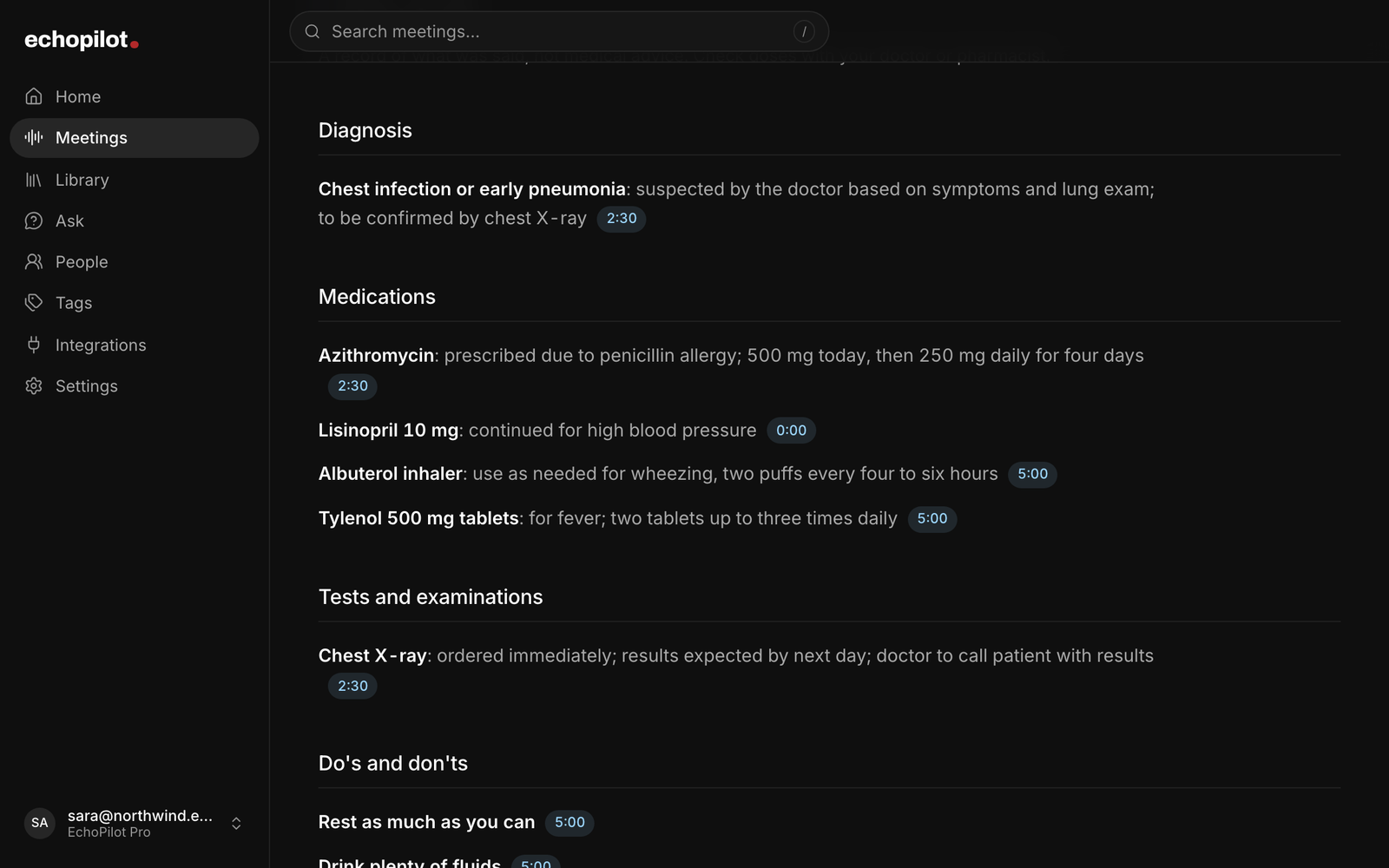
Record on your phone, or a video visit on your computer, and EchoPilot writes Doctor visit notes: what the doctor said is going on, kept as possible when the doctor said possible; each medicine with its dose and how to take it; the tests; what to do and what to avoid; the warning signs; and the follow-up. Every note is tied to the moment it was said, so a tap plays the doctor’s exact words. Ask a question later (“what did she say about the second tablet?”) and the answer cites the moment too.
The notes report what was said and never add advice: no diagnosis, no treatment suggestion, nothing the doctor did not say. A doctor visit is yours alone; it is never shared automatically, and it stays out of a Company workspace unless you share it by hand. If you record many appointments, make Doctor visit notes your default template in Settings on any device.