A listing appointment is a conversation the seller will compare with two others this week, and the agent who follows up first and most precisely usually wins it. Precision comes from the notes, and the notes are hard to take while you are also listening, walking the house and building rapport. This checklist covers what to ask, what to note and what to send, and how an AI note taker for real estate agents takes the typing off you.
Before you arrive
- Comparable sales and current listings in the area, with the dates.
- Anything public about the property: the last sale, the plot, planning history where it is available.
- The seller’s situation as far as you know it: why they are moving, and when.
- Your own numbers ready, so you quote them rather than promise to send them.
What to ask the seller
Timeline. When do they want to be sold, and when do they need to be out? A hard date changes the price conversation.
Motivation. Why now? A job move, a growing family, a downsizing, an estate. It decides how much flexibility there is on price and timing.
Price expectations. What do they think it is worth, and where does that number come from? Note the number and the source separately.
Condition and work done. What has been renewed, when, and by whom. What has not. Anything they know is wrong with the property, so that it is disclosed rather than discovered.
What they want from you. Marketing, open houses, how often they want to hear from you, and what they did not like about the last agent, if there was one.
Who decides. If a partner, a sibling or an executor needs to agree, you want to know before the paperwork.
What to note about the property
Room by room, the features that will sell it and the ones a buyer will raise: the kitchen’s age, the boiler or furnace, the roof, the windows, the parking, the garden, what the neighbours’ side looks like. Note what the seller says about the area as their words, not as a judgement: a buyer’s own view of a school or a street is theirs to form.
Record the conversation, with their agreement
A recording catches the number the seller quoted, the date they need and the sentence about the damp patch, none of which you want to reconstruct from memory in the car. Ask first: “I’d like to record this so I get your details right; it stays with me.” Recording law differs by place, and the consent guide covers the general shape, but a conversation the seller agreed to record needs no legal theory.
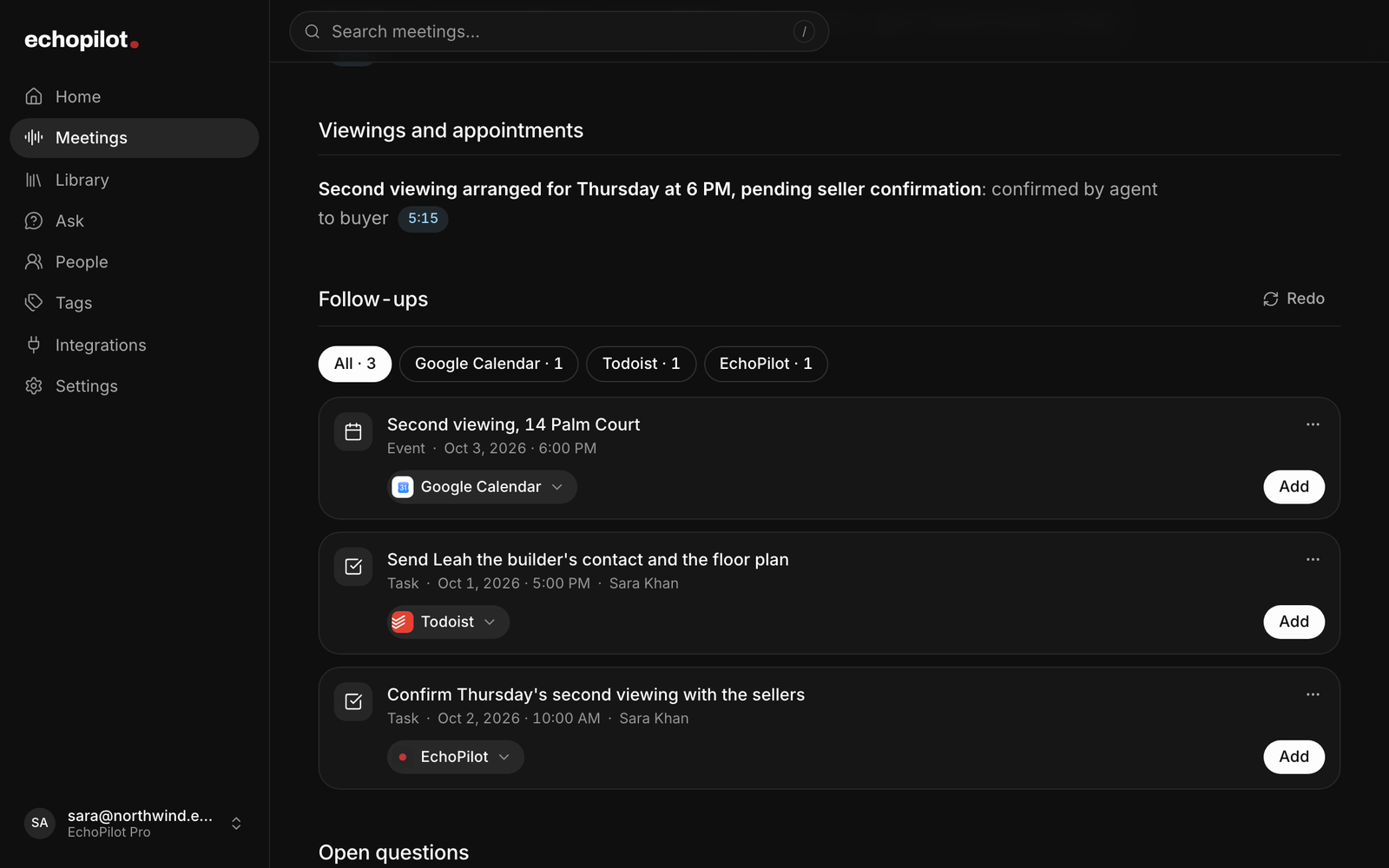
With EchoPilot, the recording is on your phone in your pocket or on the kitchen table, screen locked, and it works with no signal, so a basement or a rural lot is not a problem. What comes back is Real estate notes: the seller’s requirements and timeline, the price conversation with the figures as they were said, the property’s condition and what was disclosed, the comparables discussed, and the follow-ups, each tied to the moment it was said so you can play the seller’s own words before you rely on them. Figures are never rounded or converted, and a section the conversation did not reach stays empty.
The follow-up, within the hour
Send it the same afternoon, while the other agents are still typing:
- Thank them, and name one specific thing they said, so they know you listened.
- Confirm what you heard: the timeline, the price expectation, the work they mentioned.
- Answer the questions you promised to answer, with the numbers.
- State the next step and the date: the valuation, the marketing plan, the paperwork.
EchoPilot drafts each follow-up as a card you approve: a task in your task app, a calendar entry for the next visit, an email draft or a WhatsApp message with the details already in it. Nothing is sent until you confirm it, and there is no CRM sync; the notes export as PDF or Markdown if they need to live somewhere else.
After the appointment
Keep the notes with the client, not with the day. A seller who comes back in three months is the same conversation continued, and the question “what did they say about the kitchen?” should be answerable without rereading. Ask across a series of meetings with the same client answers it, citing the moment.